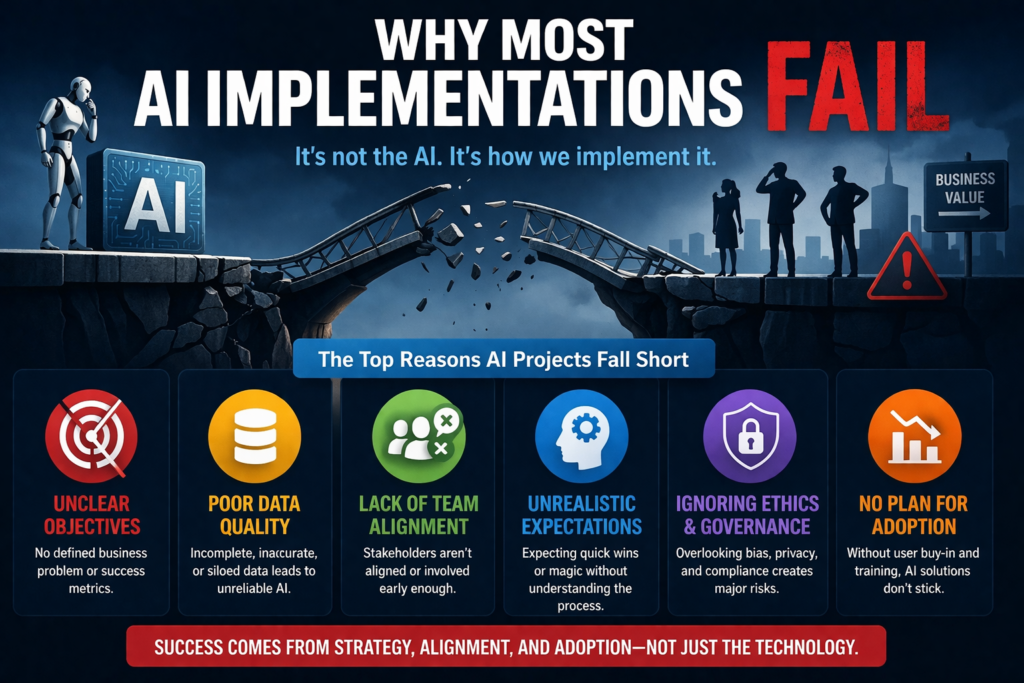
Here is a number worth sitting with: according to various industry analyses, somewhere between 70% and 85% of AI projects fail to reach production or deliver their intended value.
That is a staggering failure rate for a technology that is simultaneously being described as the most transformative of our era. And the question worth asking — particularly if you’re in the early stages of an AI initiative — is why.
The answer is almost never the technology itself.
The Myth: AI Projects Fail Because AI Is Hard
When people hear that most AI projects fail, the natural assumption is that AI is simply too complex, too unpredictable, or too immature for most organisations to use successfully.
That’s not what the data shows.
The most consistent failure patterns in AI implementations are almost entirely human and organisational:
– Starting without a clear problem to solve
– Underestimating the change management required
– Building something people don’t actually use
– Expecting results before users have had time to adapt
– Running AI as an IT project rather than a business transformation
These aren’t AI-specific problems. They’re the same patterns that cause ERP implementations, CRM rollouts, and process automation projects to fail. AI just tends to magnify them because the stakes feel higher and the hype creates unrealistic expectations.
The Six Most Common Reasons AI Implementations Fail
1. The Problem Isn’t Defined Clearly Enough
The most common failure mode starts at the very beginning: an organisation decides to “implement AI” without specifying what problem they’re trying to solve.
“We want to use AI to improve efficiency” is not a problem definition. It’s an aspiration. It doesn’t tell you which process to automate, which decision to improve, which workflow to augment, or how you’ll know if you’ve succeeded.
When the problem is vague, everything that follows is vague. The tool gets selected based on what’s most impressive in a demo rather than what fits the use case. The success criteria are never established, so it’s impossible to evaluate whether the project worked. And when results are mixed, there’s no clear basis for deciding what to do next.
What successful implementations do instead: Start with a specific, measurable problem. “Our customer service team spends 40% of their time answering the same 20 questions, and response times average 4 hours. We want to get response times below 30 minutes for common queries.” That’s a problem you can build an AI solution around and measure against.
2. Technology Is Selected Before the Use Case Is Understood
Related to the first failure: many organisations start their AI journey by selecting a platform or tool, and then try to find uses for it.
This happens because AI vendors are sophisticated marketers. A compelling demonstration of a generative AI tool or an automation platform can create enthusiasm before anyone has thought clearly about fit. Leadership gets excited about the demo and approves the budget. IT is handed the tool and told to make it work. The use cases get reverse-engineered from the technology rather than the other way around.
The result is typically a tool that is technically functional but doesn’t fit naturally into how people actually work — so adoption is low and the business case evaporates.
What successful implementations do instead: Define two or three high-value use cases first. Then evaluate which tools best fit those use cases. The best AI tool is the one that solves your specific problem most effectively — not the one with the most impressive feature list.
3. Change Management Is Treated as an Afterthought
This is possibly the most common and most consequential mistake. AI implementation teams focus the majority of their effort on the technical work — building, integrating, testing, deploying — and leave change management to the last few weeks before launch.
By that point, it’s too late to build the organisational buy-in, address employee concerns, or develop the training programmes that drive adoption. The system goes live. People use it occasionally, reluctantly, or not at all. Adoption never reaches a critical mass. The project is quietly considered a failure.
The irony is that for most AI implementations — particularly AI tools that augment how people work rather than automate processes entirely — the technology is the easier part. Convincing 200 employees to genuinely change how they do their jobs is the hard part.
What successful implementations do instead: Start change management at the beginning, not at the end. This means identifying and engaging stakeholders early, communicating the why before the what, involving employees in the design of how AI will fit into their workflows, and building a coalition of champions who can drive adoption from within the teams.
4. Pilot Groups Are Too Small or Too Homogeneous
A common approach to AI implementation is to run a pilot with a small group of early adopters — typically the most tech-enthusiastic employees who are already positive about AI. The pilot goes well. The organisation declares it a success and plans a broad rollout.
Then the broad rollout stalls, because the early adopters who drove the pilot’s success are not representative of the broader employee population. The next wave of users are less motivated, more resistant, and have different needs — and the implementation team is unprepared for this.
What successful implementations do instead: Design pilots to include a diverse cross-section of the eventual user population, including the sceptics and the less tech-savvy. This surfaces the real adoption challenges earlier, when they’re easier and cheaper to address. It also produces more credible evidence of value — a sceptic who becomes a genuine convert is far more persuasive to their peers than an early adopter who was always going to love the tool.
5. Success Metrics Were Never Established
It’s very difficult to run a successful AI project if you haven’t defined what success looks like before you start. Yet a surprising number of implementations proceed without clear KPIs.
Without metrics, every review of the project is subjective. Advocates see what they want to see. Sceptics see what they want to see. Leadership can’t make clear decisions about whether to expand, adjust, or discontinue. The project drifts.
What successful implementations do instead: Define success metrics before the project starts. For productivity tools: time saved per user per week. For automation: reduction in manual processing hours. For customer service AI: first-response time, resolution rate, customer satisfaction score. For data AI: time to insight, reduction in analyst time. These should be measured before the project starts (baseline) and at regular intervals during and after implementation.
6. Expectations Were Set by Marketing, Not Reality
AI marketing — from vendors, consultants, and media coverage — has created a widespread expectation that AI implementations produce dramatic, immediate transformation. When reality inevitably delivers something more incremental, the project is perceived as a failure even when it’s actually delivering real value.
An AI tool that saves your team 30 minutes per person per week is delivering significant, compounding value. But if leadership expected 50% productivity improvement in month one, 30 minutes per week feels like a disappointment.
What successful implementations do instead: Set expectations grounded in comparable case studies and realistic timelines before any budget is committed. Productive AI adoption is a ramp, not a step change. Week one will be slower than week eight. Month three will be better than month one. The compounding effect of AI adoption is real and significant — but it takes six to twelve months to become clearly visible at an organisational level.
What Successful AI Implementations Have in Common
Looking at the pattern from the other direction — what distinguishes AI projects that succeed?
They start small and specific. A focused pilot with clear use cases and measurable outcomes, not a broad rollout with vague goals.
They invest in change management as heavily as technology. The best implementations treat adoption as a programme, not an event.
They involve employees in the design. The people who will use the AI tool every day have the best understanding of where it can add value and where it will create friction. Successful projects build this knowledge into the design process.
They measure continuously. They establish baselines before launch and track specific metrics throughout. This generates the evidence needed to make confident expansion decisions and demonstrate ROI to leadership.
They iterate. Successful AI implementations are not completed — they evolve. Initial use cases are refined, new ones are discovered, and the programme grows as trust and capability build across the organisation.
They have executive sponsorship. Projects with a senior champion who actively participates in rollout, removes blockers, and publicly advocates for the initiative consistently outperform those managed entirely at the operational level.
The Hard Truth About AI Implementation
If you’re going into an AI project expecting the technology to carry the initiative, you’ll likely be in the majority that fails.
If you’re going into it with a clear problem, realistic expectations, a serious change management plan, and the willingness to measure and iterate, you’ll likely be in the minority that succeeds.
The technology has never been better. The limiting factor is almost always the organisational readiness and implementation approach.
How Easify AI Approaches Implementation
Our approach to AI implementation is built around the failure patterns described in this post. We start with problem definition, not tool selection. We invest heavily in change management and adoption alongside the technical work. We establish baselines and measure outcomes. And we build for the long term, not just the launch.
If you’re planning an AI initiative and want to make sure it’s in the minority that succeeds, [book a free consultation with our team](#) and let’s talk through your specific situation.